Quantum Computing Explained
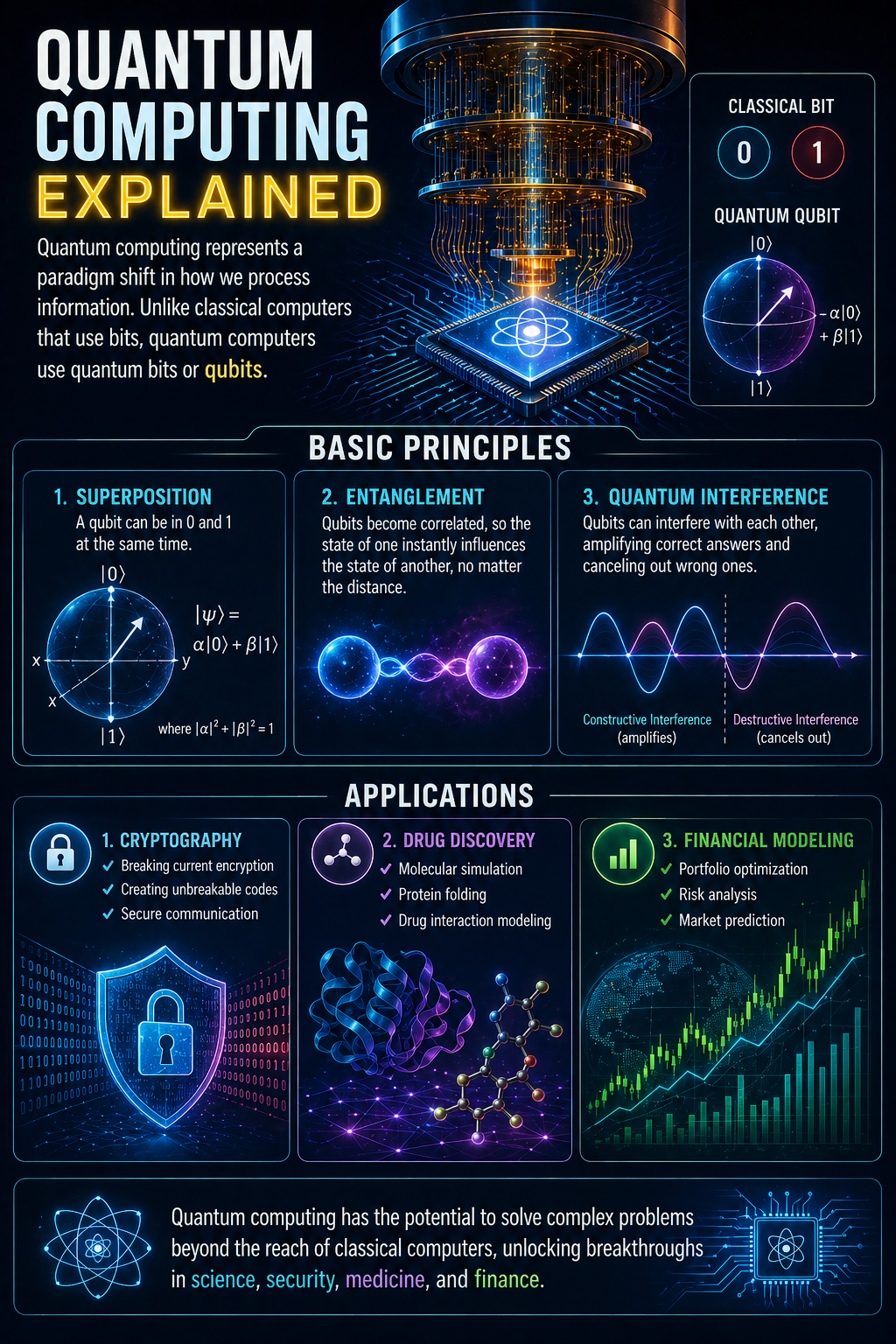
Table of Contents
Quantum computing represents a paradigm shift in how we process information. Classical computers encode information as bits that are either 0 or 1. Quantum computers use quantum bits, or qubits, whose behavior is governed by quantum mechanics. That does not make quantum computers simply "faster computers." It makes them a different kind of machine, useful for a narrower set of problems where the structure of the problem can be mapped to quantum behavior.
The practical story is still early. Researchers have demonstrated important progress in error correction, benchmark performance, and prototype applications, but today's machines remain noisy and limited. The most realistic near-term view is that quantum computers will act as specialized accelerators alongside classical high-performance computing, not as replacements for the servers, GPUs, and databases that run modern software.
Basic Principles
The key principles of quantum computing are superposition, entanglement, interference, measurement, and error correction.
Superposition means a qubit can be represented as a weighted combination of 0 and 1 before it is measured. This is often described as "being in two states at once," but the more useful interpretation is probabilistic: a quantum algorithm carefully prepares and changes probability amplitudes so that desired answers become more likely.
Entanglement connects the state of multiple qubits in a way that cannot be fully described by looking at each qubit separately. Entanglement is one reason quantum systems become difficult for classical computers to simulate. It allows quantum algorithms to represent correlations that grow very quickly as the number of qubits increases.
Quantum interference is what turns a quantum state into a computation. Good algorithms amplify the probability of useful outcomes and suppress the probability of wrong ones. Without interference, superposition is just a large collection of possibilities. With interference, the machine can guide the system toward a useful answer.
Measurement is the act of reading a quantum state. Measurement collapses the state into classical information, so quantum algorithms have to be designed around what can be learned at the end of a run. Most useful workflows run a quantum circuit many times, collect samples, and combine those samples with classical optimization or statistical analysis.
Error correction is the engineering bridge between experimental machines and useful machines. Qubits are fragile. Heat, vibration, electromagnetic noise, imperfect gates, and interactions with the surrounding environment can corrupt the state. Fault-tolerant quantum computing requires many physical qubits to encode a smaller number of more reliable logical qubits.
Recent research is encouraging but not final. Google's Willow chip showed below-threshold quantum error correction, where scaling the code reduced errors instead of increasing them, and IBM's 2025 roadmap describes a path toward a fault-tolerant Starling system with 200 logical qubits by 2029. Those milestones matter because useful quantum computing depends less on raw physical qubit counts and more on reliable logical operations.
Applications
Quantum computers could change several fields, but the timing and magnitude of impact vary by use case. The strongest candidates share a common trait: they involve complex probability, optimization, or quantum behavior that is expensive for classical machines to represent.
Cryptography
Cryptography is the clearest area where quantum computing changes planning today, even before a large fault-tolerant machine exists. Shor's algorithm showed that a sufficiently large quantum computer could break widely used public-key cryptography such as RSA and elliptic-curve systems. Grover's algorithm also changes the security margin for some symmetric-key systems, though the mitigation there is often larger key sizes.
This is why the security community is already moving toward post-quantum cryptography. In August 2024, NIST approved the first three Federal Information Processing Standards for post-quantum cryptography: FIPS 203 for ML-KEM, FIPS 204 for ML-DSA, and FIPS 205 for SLH-DSA. These standards are designed to protect key establishment and digital signatures against future quantum attacks.
The risk is not only future decryption. Sensitive data can be harvested now and decrypted later if it remains valuable long enough. Financial institutions, healthcare systems, governments, and infrastructure operators should treat crypto migration as a multi-year inventory and risk management exercise: identify where public-key cryptography is used, prioritize long-lived sensitive data, test hybrid key exchange, and prepare for certificate and protocol upgrades.
Drug Discovery and Materials Science
Quantum computers are naturally aligned with chemistry because molecules are quantum systems. Classical computers approximate molecular behavior, and the computational cost can grow quickly as molecules become larger or more strongly correlated. A useful quantum computer could improve electronic structure calculations, reaction pathway analysis, catalyst design, and materials discovery.
The near-term work is mostly hybrid. Researchers combine quantum circuits with classical optimization and machine learning to test whether quantum hardware can help with molecular simulation, molecular generation, and candidate screening. A 2025 review in npj Drug Discovery describes quantum computing as a potential tool for enhanced molecular simulation, optimization, and secure data handling in pharmaceutical research. Nature Biotechnology has also reported quantum-computing-enhanced methods for identifying potential KRAS inhibitors, an important target in oncology.
This does not mean quantum computers will automatically "solve drug discovery." Biology, clinical development, toxicity, manufacturability, and regulation remain hard. The more grounded claim is that quantum methods may eventually improve specific computational chemistry bottlenecks inside a larger discovery pipeline.
Financial Modeling
Finance has several problem types that map naturally to quantum research: portfolio optimization, derivative pricing, risk simulation, fraud detection, and scenario generation. Many of these problems involve large search spaces, constraints, uncertainty, and repeated sampling. Quantum algorithms such as quantum amplitude estimation have theoretical relevance for Monte Carlo-style workflows, while quantum annealing and variational algorithms are often explored for constrained optimization.
The main caveat is that practical advantage has not been broadly established. Many finance experiments today are proof-of-concept, quantum-inspired, or hybrid quantum-classical. That still has value. It forces teams to formalize optimization objectives, constraints, and risk functions in ways that can improve classical systems too. For a financial organization, the sensible posture is to track the field, test small pilots, and prepare security migration, while avoiding production assumptions that depend on near-term quantum speedups.
Machine Learning and AI
Quantum machine learning explores whether quantum circuits can accelerate parts of model training, kernel methods, sampling, or generative modeling. This is a research frontier, not a mature replacement for GPU-based AI. The most plausible early use cases are specialized scientific and optimization problems where quantum representations match the data or physics being modeled.
For AI teams, the more immediate impact of quantum computing may be indirect: new simulation tools for science, new optimization methods, and new security requirements for encrypted AI workflows and model supply chains.
Why Today's Quantum Computers Are Limited
Most available quantum processors are noisy intermediate-scale quantum devices. They can run meaningful experiments, but they cannot yet sustain long computations with low error rates. Several constraints matter:
- Decoherence: qubits lose their quantum state when they interact with the environment.
- Gate fidelity: each operation introduces some probability of error.
- Connectivity: not every qubit can interact directly with every other qubit.
- Readout error: measuring a qubit can return the wrong classical value.
- Scaling overhead: useful logical qubits may require many physical qubits.
That is why progress in quantum error correction is so important. A raw qubit count by itself can be misleading. A smaller system with better gates, better connectivity, and better logical error rates may be more important than a larger noisy system. For business readers, the key question is not "How many qubits does it have?" but "How many reliable logical operations can it perform for a useful workload?"
How to Evaluate Quantum Claims
Quantum computing attracts hype because the underlying physics is unintuitive and the upside is large. A careful reader should ask five questions:
- Is the result a benchmark or an application? Random circuit sampling can demonstrate quantum behavior without solving a business problem.
- Are the qubits physical or logical? Fault-tolerant applications depend on logical qubits protected by error correction.
- Is the comparison fair? Classical algorithms, hardware, and approximations improve over time too.
- Can the result be verified? Useful outputs need reproducibility and independent validation.
- Does the workflow include data movement and integration costs? A quantum speedup inside one subroutine may disappear if the surrounding workflow is inefficient.
Practical Outlook
The next several years will likely be defined by three tracks. First, hardware teams will keep improving qubit quality, modularity, and error correction. Second, algorithm researchers will search for workloads where quantum advantage can be demonstrated and verified. Third, enterprises will begin the less glamorous but urgent work of post-quantum cryptography migration.
For Kautious readers, the most important takeaway is balanced: quantum computing is real science with credible progress, but business value will arrive unevenly. Cryptography planning is actionable now. Chemistry, materials, and finance applications are promising but should be treated as research and pilot opportunities until fault-tolerant systems can run deeper circuits at useful scale.
Research Notes
- NIST approved FIPS 203, 204, and 205 for post-quantum cryptography
- Google Quantum AI announced Willow and below-threshold error correction results
- IBM's 2025 roadmap describes a path toward Starling, a fault-tolerant quantum computer
- Nature Scientific Reports described a hybrid quantum pipeline for drug discovery
- npj Drug Discovery reviewed quantum-machine-assisted drug discovery
- Financial Innovation published a systematic review of quantum computing in finance
Published on February 23, 2026 by Kautious AI
Estimated reading time: 8 minutes