The Future of AI
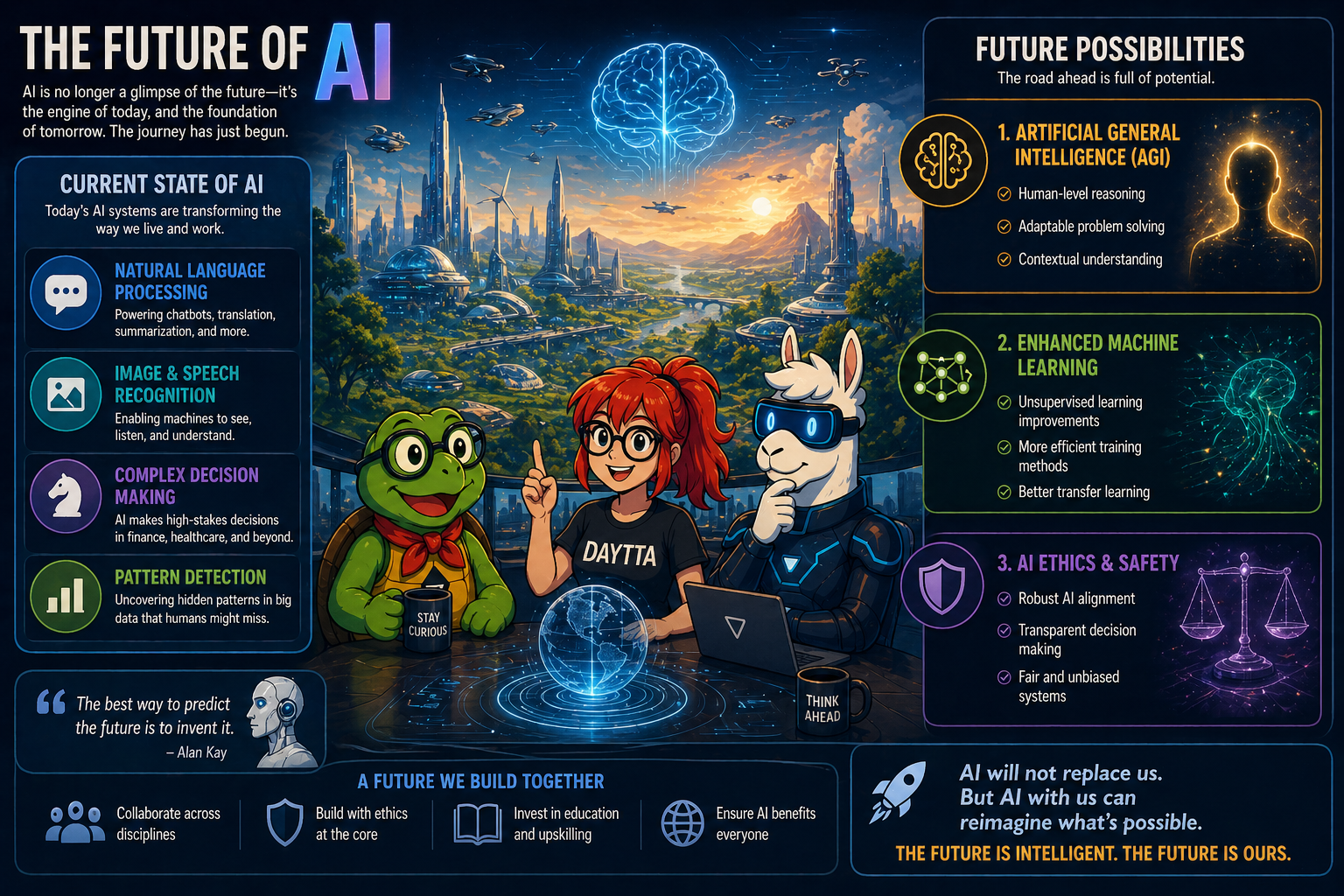
Table of Contents
Artificial Intelligence has come a long way since its inception. From rule-based systems to deep learning models, the evolution has been remarkable. The next phase will be less about whether AI can generate text, images, code, or analysis, and more about whether it can be made reliable, secure, measurable, and useful inside real institutions.
The future of AI is not a single trend. It is a collision of better models, cheaper inference, more capable agents, growing data center demand, faster adoption, and more serious governance. In finance, healthcare, education, software, and public policy, AI is moving from experimentation into operational infrastructure. That shift raises the standard: impressive demos are no longer enough.
Current State of AI
Today's AI systems are capable of natural language processing, image and speech recognition, code generation, data analysis, search, planning, multimodal reasoning, and workflow automation. The strongest systems can translate between modalities, summarize complex documents, write and debug software, analyze charts, generate video, and use tools through agentic interfaces.
The 2026 Stanford AI Index describes a field where capability is still accelerating. Frontier models improved sharply on difficult science, reasoning, math, and coding benchmarks, and organizational adoption reached 88%. At the same time, the report highlights a "jagged frontier": models can perform extremely well on some expert tasks while failing surprisingly simple ones, such as reading analog clocks or completing structured computer-use tasks reliably.
This unevenness is the defining feature of modern AI. The same model that drafts a strong legal memo may hallucinate a citation. The same coding agent that solves a difficult bug may miss a configuration detail. The same analytics assistant that finds a useful pattern may produce a misleading conclusion if the underlying data is stale, biased, or incomplete.
For organizations, the current state of AI can be summarized in four realities:
- Capability is rising quickly. Models are improving across language, code, vision, audio, reasoning, and agentic workflows.
- Costs are falling unevenly. Inference is becoming cheaper for many tasks, but frontier training and data center infrastructure remain capital intensive.
- Adoption is faster than governance. Many teams use AI before they have mature policies, evaluation systems, or incident response plans.
- Reliability is context dependent. AI works best when the task is bounded, the data is available, the output can be checked, and humans remain accountable for consequential decisions.
Future Possibilities
The future of AI looks promising, but the most important developments will not be only bigger models. They will involve better systems around the models: retrieval, tools, evaluation, monitoring, security, and domain-specific workflows.
Artificial General Intelligence
Artificial General Intelligence, or AGI, usually refers to AI that can perform a broad range of cognitive tasks at or above human level. There is no single agreed-upon test for AGI, which makes the topic difficult to evaluate. Benchmarks can measure math, coding, reasoning, tool use, and scientific knowledge, but no benchmark fully captures judgment, robustness, motivation, social context, or accountability.
The practical path toward more general systems is likely to involve several ingredients:
- Longer-horizon reasoning: models that can break work into steps, recover from errors, and manage uncertainty over time.
- Tool use: systems that call databases, code interpreters, browsers, spreadsheets, APIs, and domain software instead of relying only on model weights.
- Memory and personalization: agents that can maintain context across sessions while respecting privacy and access controls.
- Self-checking and verification: workflows where outputs are tested, simulated, cross-examined, or reviewed before action.
- Embodied and interactive learning: systems that learn from operating in environments, whether digital desktops, robotics labs, or industrial settings.
The most important question is not whether a model can appear intelligent in a conversation. It is whether the full system can operate safely under distribution shift, adversarial pressure, incomplete information, and real-world consequences.
Enhanced Machine Learning
The next wave of machine learning will focus on efficiency and specialization as much as scale. Several research directions matter:
Smaller capable models. Distillation, quantization, sparse architectures, and better training data allow smaller models to perform well on specific tasks. This matters for latency, privacy, edge deployment, and cost control.
Retrieval-augmented generation. Instead of asking a model to remember everything, systems can retrieve current documents, market data, policies, or customer records and ground the answer in that context. This is especially important in finance, where stale or untraceable answers create risk.
Synthetic and curated data. Model quality depends heavily on data quality. Synthetic data can help with rare cases and privacy-preserving workflows, but it can also amplify errors if not validated.
Multimodal learning. Future systems will treat text, audio, video, code, tables, charts, and sensor data as parts of the same problem. In finance, that could mean combining filings, earnings calls, price action, macro data, and news into one analytical workflow.
Agentic workflows. Agents will increasingly plan tasks, call tools, monitor results, and hand work back to humans. The opportunity is automation of multi-step workflows. The risk is that an agent can make a chain of small mistakes that compound before anyone notices.
AI in Science, Medicine, and Finance
Scientific AI is one of the most promising frontiers. Models are already helping with protein structure, molecular design, materials discovery, weather forecasting, and laboratory planning. The long-term impact may come from AI systems that generate hypotheses, design experiments, analyze results, and accelerate simulation.
In medicine, AI can help with triage, imaging, documentation, clinical decision support, drug discovery, and patient engagement. But medical AI must be evaluated differently from consumer AI. Safety, bias, privacy, explainability, clinical validation, liability, and workflow fit matter as much as raw model performance.
In finance, AI will likely become embedded in research, risk management, compliance, fraud detection, customer operations, portfolio analytics, and trading infrastructure. The highest-value systems will not be generic chatbots. They will be domain-aware assistants connected to governed data, permissioned tools, audit trails, and measurable controls.
For example, a financial AI assistant should be able to answer "What changed in this issuer's risk profile since last quarter?" by reading filings, comparing covenants, checking exposure, citing source documents, and flagging uncertainty. It should not simply generate a confident narrative.
AI Ethics and Safety
The future of AI depends on whether institutions can manage risk without freezing useful innovation. The NIST AI Risk Management Framework gives organizations a practical structure around four functions: govern, map, measure, and manage. The OECD AI Principles, updated in 2024, emphasize trustworthy AI that respects human rights, democratic values, transparency, safety, and accountability.
Safety work is becoming more technical and more operational. It includes:
- Alignment: making systems follow human intent and institutional policy.
- Robustness: keeping performance stable under messy inputs, edge cases, and attacks.
- Security: defending against prompt injection, data exfiltration, model theft, and malicious tool use.
- Fairness: measuring and reducing disparate impact across groups.
- Transparency: documenting training data, limitations, evaluations, and known risks.
- Accountability: ensuring a human or organization remains responsible for consequential outcomes.
The 2026 International AI Safety Report synthesizes evidence on the capabilities, emerging risks, and safety of general-purpose AI systems. Its existence reflects a broader shift: AI safety is no longer only a philosophical debate. It is becoming a measurement, audit, policy, and engineering discipline.
What Could Slow AI Down
AI progress is not guaranteed to continue smoothly. Several constraints could shape the next decade:
Compute and energy. Frontier AI requires large data centers, specialized chips, power, cooling, and supply chains. Stanford HAI's 2026 analysis highlights the growing energy and infrastructure footprint of AI systems.
Data limits. High-quality human-generated data is finite. Future improvement may depend on better curation, domain data partnerships, synthetic data, simulation, and feedback from real-world use.
Evaluation limits. Benchmarks saturate quickly and can be gamed. Organizations will need private evaluations tied to their own risk, workflows, and failure modes.
Regulatory fragmentation. Different jurisdictions are moving at different speeds. Global companies will need compliance strategies that handle the EU, United States, China, and other regulatory regimes.
Trust and public acceptance. Adoption can be slowed by visible failures, labor disruption, privacy concerns, copyright disputes, security incidents, or unclear accountability.
A Practical Forecast
The most likely future is not one giant AI replacing everyone. It is a layered ecosystem:
- Everyday copilots will support writing, analysis, coding, search, scheduling, and document work.
- Domain agents will handle bounded workflows in finance, legal, medicine, engineering, and operations.
- Autonomous systems will operate in constrained environments where actions can be monitored and reversed.
- Scientific AI platforms will accelerate discovery through simulation, hypothesis generation, and experiment design.
- Governance systems will become a required layer: evaluations, permissions, logging, red-teaming, incident response, and model risk management.
For financial technology, the winning AI systems will be boring in the best sense: permissioned, observable, auditable, and integrated into workflows where experts can verify outputs. The future belongs less to AI that sounds certain and more to AI that knows when to cite evidence, ask for missing data, call a tool, or escalate to a human.
Research Notes
- Stanford HAI 2026 AI Index Report
- Stanford HAI 2026 Technical Performance chapter
- NIST AI Risk Management Framework 1.0 announcement
- OECD AI Principles overview
- International AI Safety Report 2026
Published on March 2, 2026 by Kautious AI
Estimated reading time: 8 minutes